
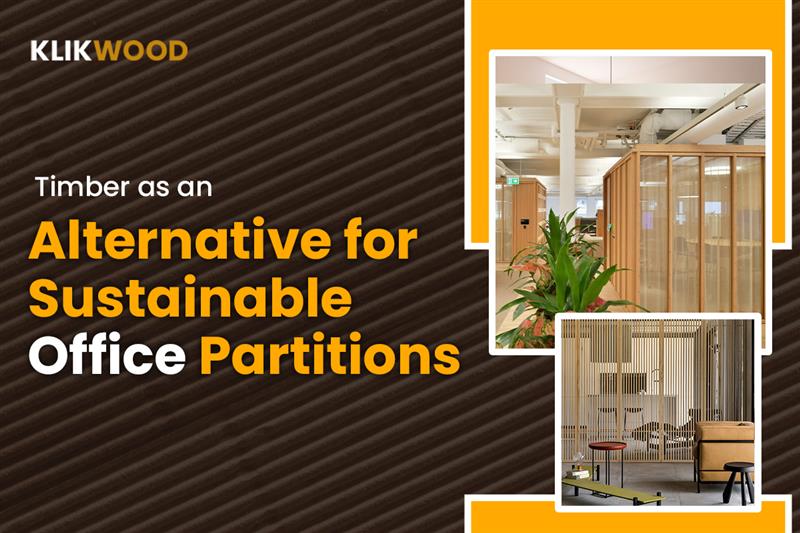
Office partitions are beneficial for acoustic management and aesthetic purposes. However, traditional materials like glass or gypsum are heavy carbon emitters and are detrimental to the environment. As global demand for sustainability increases, pressure on commercial spaces to adopt green practices is mounting. In such times, many are looking to timber as an alternative for sustainable office partitions.
The Problem with Conventional Office Partitions
Glass Office Partitions
Glass is one of the earliest materials used for office partitions. It provides sophistication and transparency, which adds value to the commercial spaces. However, glass is notorious for its carbon emissions and its limited role in acoustic performance. Its main problems in detail are as follows:
- High energy consumption during manufacturing: Glass is formed from crystallising sand particles, for which it needs heat. Thus, glass partitions take substantial energy during manufacturing. The heat in smouldering plants releases greenhouse gases and other toxic materials into the atmosphere. These substances are not conducive to human health.
- Limited acoustic management: Glass may be transparent, but it does not absorb sound. Therefore, its function as an office partition is limited.
Gypsum (Plasterboard) Partitions
Gypsum is composed of calcium sulfate, used as plaster and cement for construction. When mixed with water, it hardens into a solid quickly. It has found its appeal in office spaces due to its strength and acoustic management as office partitions. However, it has its disadvantages, which are the following:
- Unrecyclable: Gypsum cannot be reused for rebuilding a new office partition or any other purpose. Thus, the structure is not portable and customisable in any way.
- High waste generation: Gypsum produces large amounts of debris during construction and renovation. The dust during construction can cause breathing problems and be harmful to the environment.
- Short lifespan: Gypsum partition walls have a shorter lifespan than timber or glass partition walls. It needs constant maintenance and replacement, which adds renovation costs.
Why Timber is a Better Option for Sustainable Office Partitions
Renewable material source
Timber is a natural resource obtained from wood, which is abundantly present. Timber can be renewed and does not need a massive manufacturing process for production, unlike glass or gypsum. This quality makes it the best contender for sustainable office partitions. Renewable materials such as timber save costs on maintenance and reduce environmental impact.
Long lifespan and adaptability
Timber is a flexible material which can be adapted for a variety of commercial layouts. Timber office partitions are also available in various designs and colours. Additionally, timber has a longer span than traditional materials such as glass and gypsum. It is heat-resistant and sustains less damage than traditional materials.
Reduced Embodied Carbon
Timber is naturally sourced from the wood of trees processed into beams, planks and boards. Processing doesn’t always require machines and hence does not consume any energy. The machine that is used occasionally for large-scale projects doesn’t consume much energy. Timber production produces less waste, and the byproducts can be used for other purposes.
Better Acoustic Control
Timber is a better acoustic manager than glass and gypsum. Its porous structure obstructs and redirects sound waves without letting echoes throughout the space. Thus, it maintains office privacy, making it one of the best sustainable office partitions.
Performance Comparison
| Performance Factor | Timber Office Partitions | Glass Office Partitions | Gypsum (Plasterboard) Partitions |
| Sustainability & Environmental Impact | Renewable material | High embodied energy due to intensive manufacturing and processing | Non-renewable raw materials and energy-intensive production |
| Embodied Carbon | carbon-negative | High embodied carbon from production | high replacement lifecycle emissions |
| Acoustic Performance | Naturally sound-absorbing | Poor acoustic insulation | Performance degrades with |
| Visual Privacy | Strong visual separation | Limited privacy unless frosted | Enclosed |
| Design & Aesthetic Value | Warm, natural appearance | Overly corporate | Limited visual appeal |
| Flexibility & Adaptability | Can be easily customised | Harder to adapt once installed | Low flexibility |
| Durability & Impact Resistance | High durability in commercial environments | Prone to cracking, chipping | Prone to dents, moisture damage, and frequent repairs |
Conclusion
Choosing timber is not only an aesthetic decision but a functional one. Timber can make your office sustainable by reducing carbon emissions and high energy consumption. The intensive manufacturing process of traditional materials for office partitions has detrimental effects on the environment. Additionally, it offers limited functionality as office partitions. Glass and gypsum have less flexibility and do not manage sound. In such circumstances, timber offers an alternative option for sustainable office partitions. If you are looking for the best quality partitions for your commercial space, Klikwood is the best option. Klikwood is Australia’s timber partition manufacturer. We offer customised partitions based on the client’s needs. Visit our official website to check our array of products and portfolio.